THHN / THWN building wire
THHN and THWN are the most common leftover wire on any commercial or industrial job.
Wire we buy
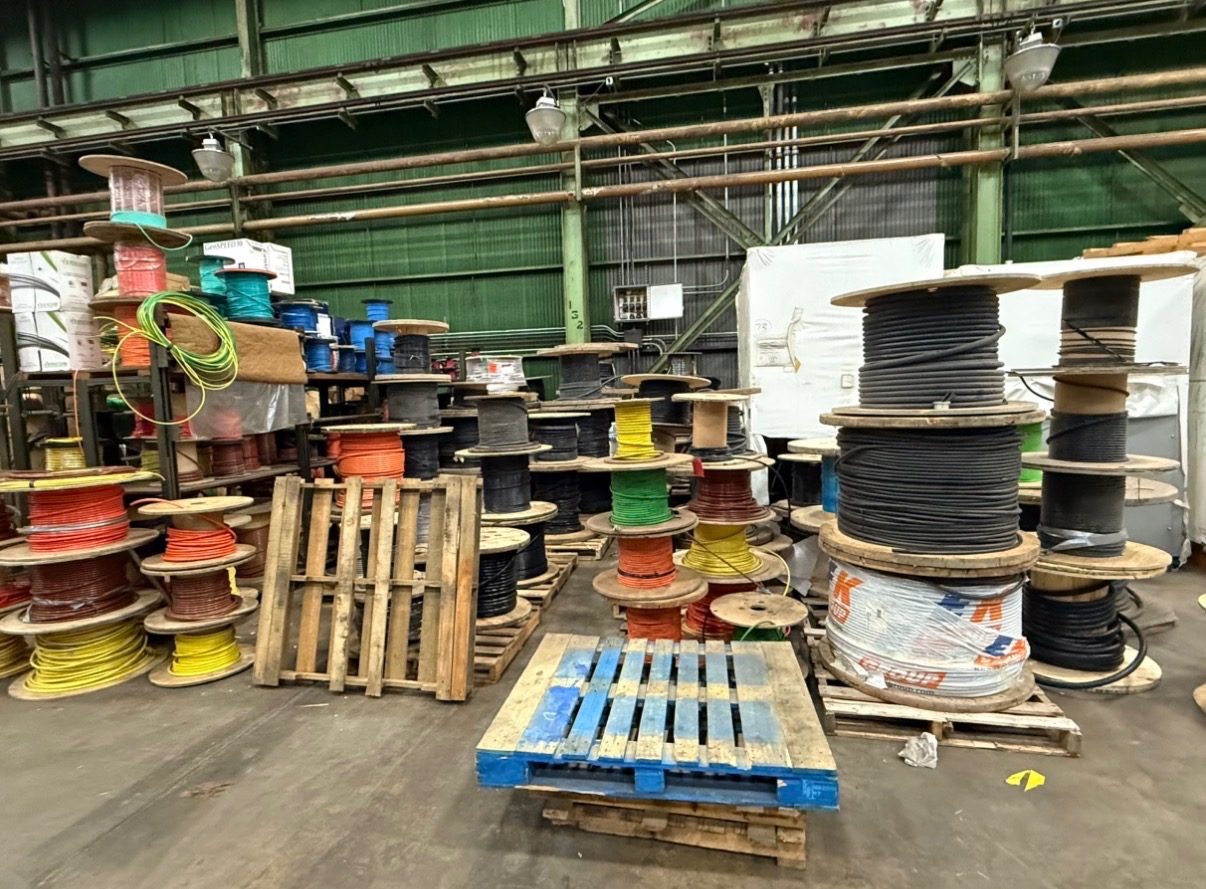
XHHW and XHHW-2 appear on feeders, service entrances, rooftop units and industrial power runs, often in sizes from #6 up to 750 MCM. Large-size surplus is where the value sits, and where a clear photo of the reel tag matters most.
01Overview
XHHW is a cross-linked polyethylene insulated wire with a moisture- and heat-resistant jacket; XHHW-2 adds a higher temperature rating. It is used where wet locations, high ambient temperatures or large feeder sizes make THHN a poor fit, so it tends to show up on bigger projects: plants, water and wastewater facilities, substations, data centers and large commercial shells.
Because those projects order in specific cut lengths, a cancelled or descoped job can leave full 1,000-foot reels of 350 or 500 MCM sitting in a laydown yard. That is the material we are most interested in.
02Specifications
| Common constructions | XHHW, XHHW-2, XHHW-2 with sunlight-resistant jacket, dual-rated RHW-2/USE-2 |
|---|---|
| Conductor metal | Copper or aluminum (compact and compressed stranded) |
| Typical sizes | #14 through 4/0, plus 250, 300, 350, 400, 500, 600, 750 and 1000 MCM |
| Voltage rating | 600V, with 1kV and 2kV constructions seen in industrial work |
| Colors | Black, red, blue, white, green, brown, orange, yellow, gray |
| Packaging we see | 1,000 ft reels, 2,500 ft reels, cut lengths on spools |
03Details
Above 4/0, wire is sold by the foot against a conductor weight, so the size, strand class and conductor metal drive the value. A reel of 500 MCM aluminum and a reel of 500 MCM copper look similar from ten feet away and are worth very different amounts. The reel tag settles it, and a tape measure across the conductor helps when the tag is gone.
If the reel is sealed in factory wrap and the tag is legible, say so. Sealed factory reels with intact tags are the easiest lots to quote and usually the strongest.
Aluminum XHHW and XHHW-2 in 1/0 through 500 MCM is common in Wyoming on service and feeder work, including agricultural services, shop buildings and plant distribution. Aluminum is worth quoting in quantity, and we will be honest when a small aluminum lot is not worth the freight.
XHHW tolerates moisture better than many insulations, but it still does not like years of direct sun, standing water or being crushed under other reels. Tell us whether it was stored indoors, in a conex, under tarp or outdoors in the open, and whether the jacket shows cracking, flattening or UV chalking.
04Questions
The dual-rated, higher-temperature construction is more broadly usable, so it can be easier to place. The difference in a quote depends on size, metal and condition as much as the rating.
Yes, if they are coiled, labelled and long enough to be useful. Loose wire without a readable tag is harder to place and is priced accordingly.
If the tag or the printed legend is visible, usually yes. If neither is readable, we may ask for two or three close photos before quoting.
05Request a quote
Tell us the size, metal, voltage and footage, and attach photos of the tags. If something is unknown, leave it blank and describe it in the notes.
Send the reel details and photos. We will tell you what the lot is worth and how a pickup would work.
06Keep reading
THHN and THWN are the most common leftover wire on any commercial or industrial job.
Metal-clad and armored cable arrives on site in 250-foot and 1,000-foot coils, gets cut for a dozen branch runs, and leaves a stack of partial coils behind.
Find the corridor your material sits in, from Cheyenne to Cody.