XHHW and XHHW-2
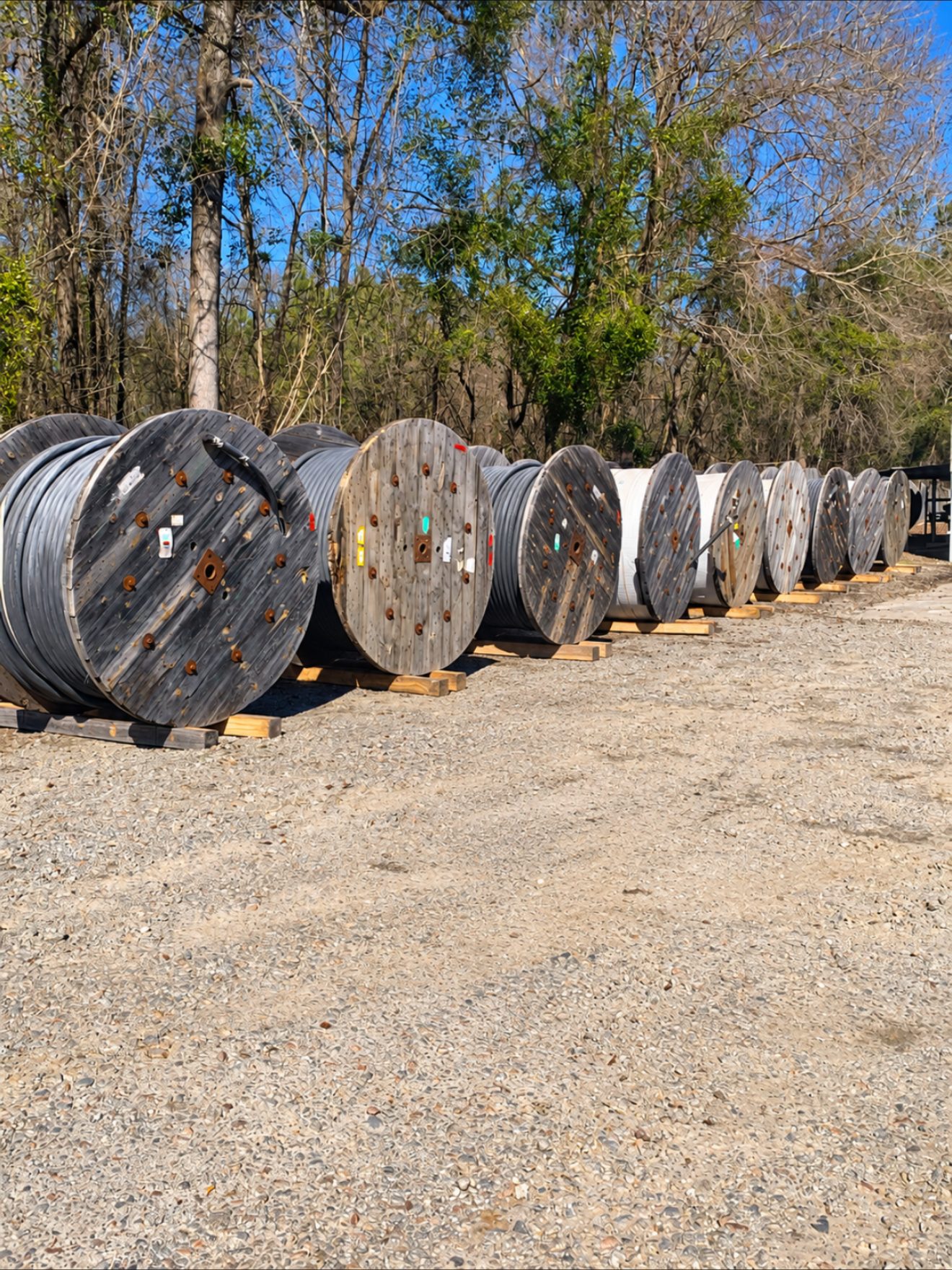
XHHW and XHHW-2 appear on feeders, service entrances, rooftop units and industrial power runs, often in sizes from #6 up to 750 MCM.
Wire we buy
THHN and THWN are the most common leftover wire on any commercial or industrial job. If a project ended with partial reels, cancelled orders or unopened cartons, send the tags and a photo of each reel and we will quote the lot.
01Overview
THHN, THWN and THWN-2 are thermoplastic-insulated building wires used for branch circuits and feeders in conduit. Because they are ordered in specific colors and cut lengths, projects routinely finish with a mixed tail of 500-foot and 1,000-foot reels, half-used spools and cartons that were never opened. That tail is exactly what we buy.
Copper is the most common conductor we see, and aluminum THHN and XHHW feeders show up regularly on larger commercial jobs. Both are worth quoting, but they price differently, so the conductor metal has to be clear before we can put a number on the lot.
02Specifications
| Common constructions | THHN, THWN, THWN-2, T90 nylon-jacketed, MTW where dual-rated |
|---|---|
| Conductor metal | Copper (solid and stranded) or aluminum |
| Typical sizes | #14, #12, #10, #8, #6, #4, #2, #1, 1/0 through 4/0, 250 – 500 MCM |
| Voltage rating | 600V (300V where marked) |
| Colors | Black, red, blue, white, green, brown, orange, yellow, gray, purple, pink |
| Packaging we see | 500 ft and 1,000 ft reels, 2,500 ft and 5,000 ft master reels, spools, cartons |
03Details
The printed legend on the wire jacket tells us the insulation type, size, voltage rating and approval marks in one line — for example a wire printed as THHN/THWN-2, 12 AWG, 600V. A close photo of that print beats any description. If the reel tag is still attached, photograph it too, because tags carry the manufacturer, footage and date code.
Partial reels are fine. We care whether the remaining footage can be estimated from the tag or a counter, and whether the wire has been dragged, kinked or stored outdoors in UV. Wire that has sat in a yard for three summers is a different material from wire that stayed indoors in a warehouse.
Commercial and industrial electrical contractors finishing schools, hospitals, plants and data-center fit-outs; plant maintenance groups replacing feeders during turnarounds; electrical distributors clearing discontinued colors; and agricultural facilities rewiring irrigation and grain systems. We also see full reels from cancelled projects where the material was delivered and never installed.
Mixed lots are welcome. A pallet with twelve partial reels in six colors is normal, and it does not need to be sorted before you contact us — but list what you can see. If the lot is large, grouping by size and color in the description speeds the quote up considerably. Very small quantities of common sizes may be worth less than the freight, and we will say so rather than waste your time.
04Questions
Often, yes, depending on size, color and condition, and usually as part of a larger lot rather than as a single small reel. Send the footage you can read from the tag and a photo of each reel and we will tell you what the lot is worth as a whole.
It affects how easily we can place the material. Black, red, blue, white and green move best; odd colors in small quantities are harder. It does not stop us from quoting, it changes the number.
Sometimes, if it was pulled cleanly and the jacket is intact. Used wire must be clearly described as used or pulled so it is priced as such.
05Request a quote
Tell us the size, metal, voltage and footage, and attach photos of the tags. If something is unknown, leave it blank and describe it in the notes.
Send the reel details and photos. We will tell you what the lot is worth and how a pickup would work.
06Keep reading
XHHW and XHHW-2 appear on feeders, service entrances, rooftop units and industrial power runs, often in sizes from #6 up to 750 MCM.
Metal-clad and armored cable arrives on site in 250-foot and 1,000-foot coils, gets cut for a dozen branch runs, and leaves a stack of partial coils behind.
Find the corridor your material sits in, from Cheyenne to Cody.