THHN / THWN building wire
THHN and THWN are the most common leftover wire on any commercial or industrial job.
Wire we buy
Aluminum feeders, service-entrance cable and underground distribution cable are heavy, awkward to store and expensive to replace. When a project leaves them behind, they are worth a conversation.
01Overview
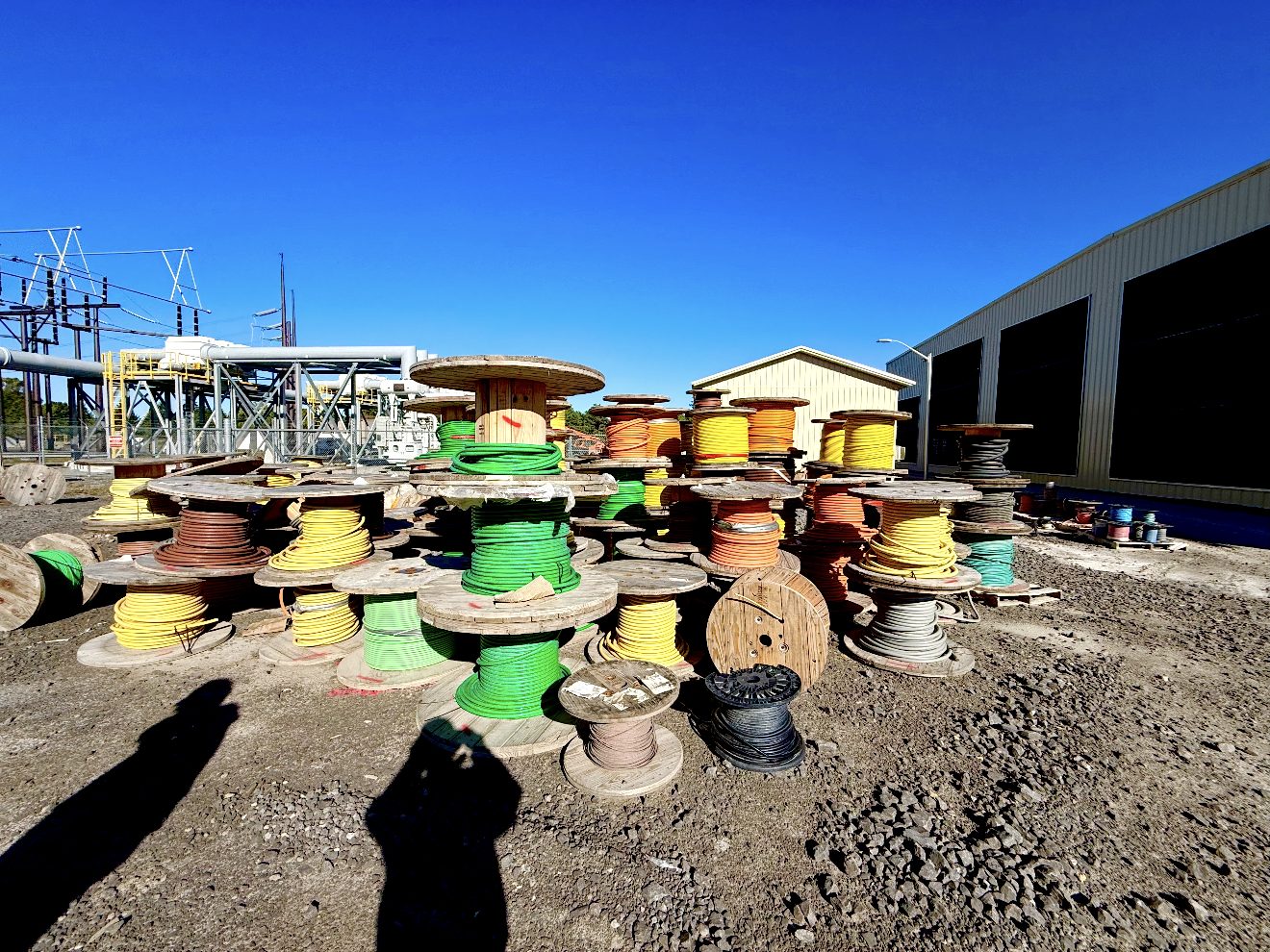
Aluminum conductors are the default for larger feeders and service entrances because they cost less per amp than copper at big sizes. The surplus we see is mostly SER and SEU service cable, XHHW and THHN aluminum feeders, URD and USE-2 direct-burial cable, and aluminum medium-voltage cable from utility and wind work.
Aluminum is worth less per pound than copper, so quantity matters more. A single partial reel of 2/0 URD is rarely worth a dedicated trip; a pallet of service cable from a cancelled subdivision is a different story.
02Specifications
| Common constructions | SER, SEU, XHHW/XHHW-2 aluminum, THHN aluminum, URD, USE-2, MV-90 and MV-105 aluminum |
|---|---|
| Typical sizes | #6 through 4/0, plus 250, 300, 350, 500 and 750 MCM |
| Configurations | Single conductor, 2-2-2-4 and 4-4-4-6 service cable, triplex and quadruplex URD |
| Voltage rating | 600V for building and service cable; 15kV and 25kV for distribution cable |
| Packaging we see | 500 ft and 1,000 ft reels, 2,500 ft reels, partial reels, cut lengths |
03Details
SER and SEU are service-entrance assemblies with aluminum conductors; URD and USE-2 are direct-burial cables used for underground feeders, yard lighting and outbuildings. In rural Wyoming these are everywhere, and partial reels from agricultural and subdivision work are common surplus.
Tell us whether the cable is jacketed or unjacketed, whether it is triplex or quadruplex, and whether the ends have been sealed against water. Underground cable that sat with open ends in a wet yard is a different material.
Aluminum MV cable from wind projects, substations and utility distribution work is worth quoting when the footage is substantial and the reel tags survive. Include the voltage class, insulation type (EPR or XLPE) and whether it is shielded with a concentric neutral.
Electrical contractors after service upgrades, agricultural operations that changed out a service or irrigation system, utilities and their contractors after distribution rebuilds, and industrial plants after feeder replacements. Also distributors holding discontinued sizes.
04Questions
In quantity, yes. Aluminum is priced far below copper per pound, so small lots often are not worth the freight. Send the weights or reel counts and we will tell you honestly whether a pickup makes sense.
We can, but they need to be described separately. Mixed unidentified reels are priced as a mixed lot rather than at their best use.
05Request a quote
Tell us the size, metal, voltage and footage, and attach photos of the tags. If something is unknown, leave it blank and describe it in the notes.
Send the reel details and photos. We will tell you what the lot is worth and how a pickup would work.
06Keep reading
THHN and THWN are the most common leftover wire on any commercial or industrial job.
XHHW and XHHW-2 appear on feeders, service entrances, rooftop units and industrial power runs, often in sizes from #6 up to 750 MCM.
Find the corridor your material sits in, from Cheyenne to Cody.