Wyoming service areas
Find the corridor your material sits in, from Cheyenne to Cody.
Wire we buy
Control and instrumentation cable is ordered by the pair count and shield type against an index, so a plant change order leaves odd spools that nobody wants to stock. We buy them by the lot.
01Overview
Control cable carries switching and status signals between panels, motors and field devices. Instrumentation cable carries low-level analog signals, usually as twisted pairs with an overall shield, and thermocouple extension wire carries a millivolt signal from a sensor to a transmitter or PLC card.
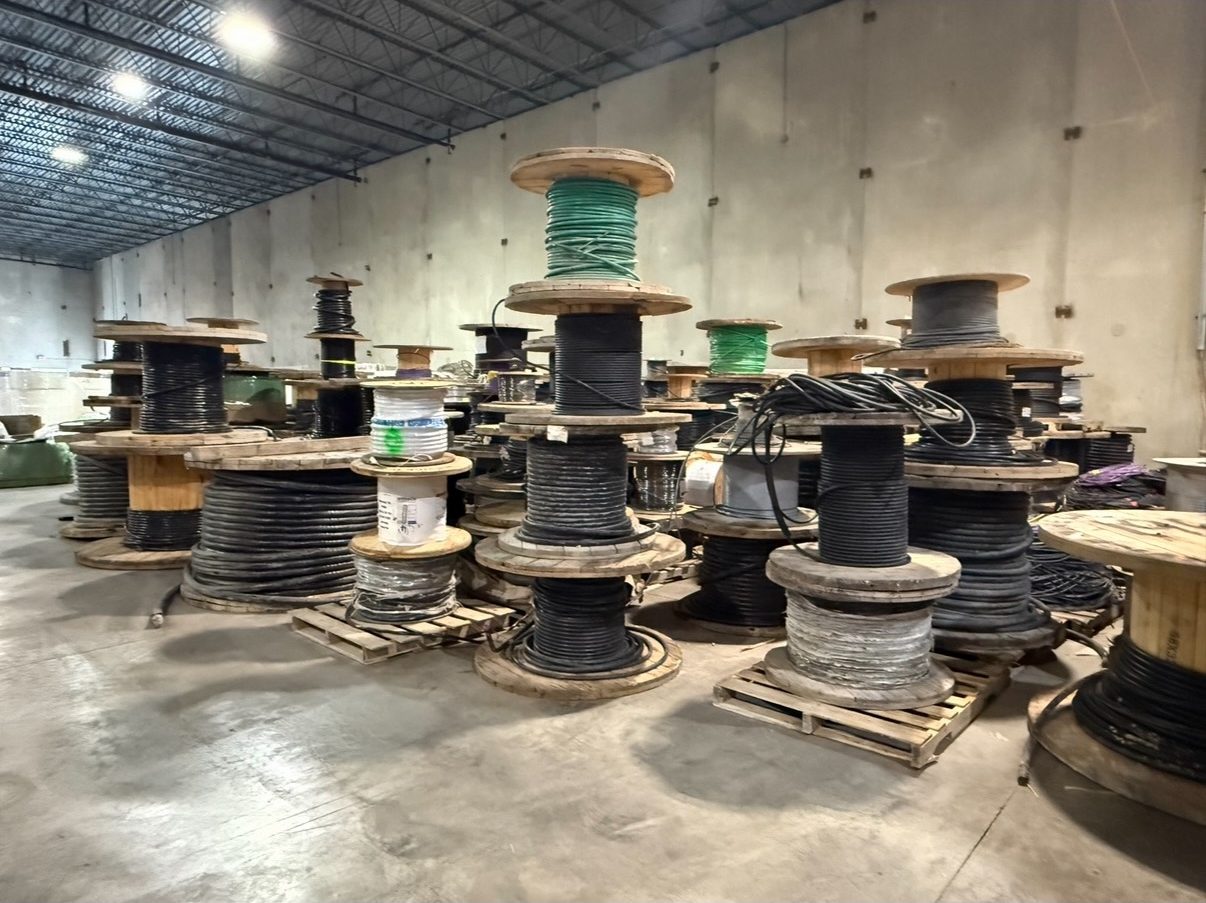
Because these cables are specified pair-by-pair, plants and integrators end up holding partial 500-foot and 1,000-foot spools of a dozen different constructions. Individually they are awkward; as a lot they are worth quoting.
02Specifications
| Common constructions | Tray-rated control cable, shielded twisted pair instrumentation cable, thermocouple extension (J, K, T, E types), fire-rated control cable |
|---|---|
| Conductor | Stranded copper, typically #18, #16 and #14 |
| Configurations | 2 to 37 conductor control; 1 to 24 pair instrumentation; triads |
| Shielding | Overall foil, braid, or individually shielded pairs |
| Voltage rating | 300V and 600V, with 1kV industrial constructions |
| Packaging we see | 500 ft and 1,000 ft spools, partial spools, cut lengths in cartons |
03Details
Two spools that look identical can be a 4-pair individually shielded 16 AWG and a 12-conductor overall shielded 18 AWG, and they do not trade the same. The jacket legend and the spool label carry the pair count, AWG, shield and voltage. Photograph the label square-on rather than at an angle; we would rather read ten labels than guess one.
Thermocouple extension wire is identifiable by its color-coded jacket and the calibration letter printed on it. It is worth listing separately from general control cable because buyers for it are specific. The same applies to fire-rated control cable and any cable with a published fire-resistance rating.
Instrumentation cable dislikes moisture in the shield and crushed spools. Tell us where it was stored and whether the spool flanges are intact. Cable that has been in a climate-controlled warehouse is a different proposition from cable that spent four winters in a conex.
04Questions
A pallet photo helps us understand the size of the lot, but we still need legible labels or jacket legends. Two or three close photos covering the different constructions is usually enough.
Usually as part of a mixed lot. A single partial spool rarely justifies a pickup on its own, and we will tell you that directly.
05Request a quote
Tell us the size, metal, voltage and footage, and attach photos of the tags. If something is unknown, leave it blank and describe it in the notes.
Send the reel details and photos. We will tell you what the lot is worth and how a pickup would work.
06Keep reading
Find the corridor your material sits in, from Cheyenne to Cody.